What are ROPP Bottle Capping Machines and How Do They Work?
Roll-On Pilfer-Proof (ROPP) bottle capping machines represent the pinnacle of liquid packaging security, widely deployed across premium spirits, wine (Stelvin closures), pharmaceutical elixirs, and high-purity edible oils. Unlike pre-threaded plastic caps that are simply torqued onto bottle finishes, ROPP closures start as unthreaded, smooth aluminum shells containing an inner resilient liner (such as Saranex, tin-foil, or EPE foam).
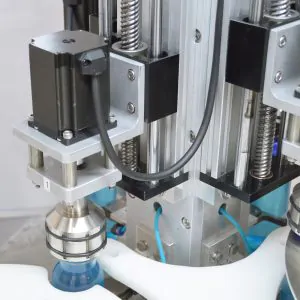
During the sealing cycle, the ROPP capping head descends onto the bottle neck. An overhead compression spring or pneumatic pressure block applies a constant vertical downward load (top load), firmly compressing the inner liner against the bottle rim to create a gastight, liquid-hermetic seal. As the capping head rotates around the container neck, motorized or cam-actuated stainless steel rollers press horizontally against the unthreaded aluminum shell:
- Thread-Forming Rollers: Follow the existing glass or rigid container thread geometry, cold-forming the soft aluminum wall into precise, mirror-matched helical threads.
- Skirt-Tucking (Crimping) Rollers: Roll the bottom edge of the aluminum cap under the container's lower locking ring (pilfer ring), creating an unalterable, tamper-evident security band.
Engineering Information Gain: Top Load vs. Threading Torque Balance
A common failure mode in low-tier ROPP cappers is top-seal weeping caused by improper load sequencing. Accutek’s engineering design ensures that 100% of the top load pressure is fully established and locked before the side threading rollers make contact with the aluminum shell. This prevents cap rotational slip, eliminates metal shaving generation, and guarantees consistent removal torque across varying glass bottle neck tolerances.
Engineered for Production Scale
Accutek ROPP Bottle Capping Machine Series
From craft distilleries to high-speed commercial bottling operations, explore our custom-configured ROPP sealing solutions.
Semi-Automatic ROPP Benchtop Capper
Ideal for craft distilleries, boutique wineries, and R&D laboratories. Features a single pneumatic 4-roller capping head with dual safety start buttons and foot-pedal control. Fast changeovers for 28mm to 31.5mm closures with throughput up to 15-20 BPM.
Automatic Inline High-Torque ROPP Capper
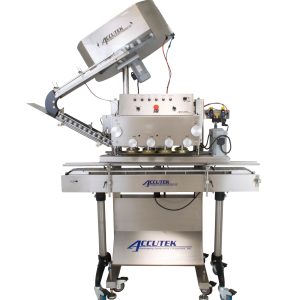
Designed for medium-to-large bottling lines. Features an automatic cap vibratory bowl feeder, cap chute, photo-electric bottle indexing, and a single-head or twin-head heavy-duty ROPP sealing column. Handles production speeds up to 60-80 BPM with zero bottle deformation.
High-Speed Rotary Multi-Head ROPP Bottling Line
Fully integrated monoblock capping tower with 4, 6, 8, or 12 rotary capping heads. Synchronized with starwheel indexing and servo-driven dynamic torque control. Speeds up to 300+ BPM with continuous vision inspection and reject stations.
Technical Specification Matrix: ROPP Capping Machinery
Compare key mechanical parameters across Accutek’s ROPP machine portfolio to match your container geometry, cap profile, and target overall equipment effectiveness (OEE).
| Machine Feature / Parameter |
Semi-Auto ROPP Benchtop |
Automatic Inline ROPP Capper |
Rotary Monoblock ROPP System |
| Target Throughput (BPM) |
10 - 20 Bottles/Min |
40 - 80 Bottles/Min |
120 - 300+ Bottles/Min |
| Cap Diameters Handled |
18mm - 38mm |
18mm - 45mm (Stelvin 30x60) |
18mm - 53mm Custom |
| Head Configuration |
1 Head (4 Rollers) |
1 or 2 Heads (Independent) |
4, 6, 8, or 12 Rotary Heads |
| Top-Load Pressure Mechanism |
Adjustable Mechanical Spring |
Pneumatic Air Cylinder / Spring |
Closed-Loop Servo Control |
| Container Material Compatibility |
Glass, Rigid HDPE, Aluminum |
Glass, Rigid PET, Aluminum |
Glass, Heavy-Wall Containers |
| Changeover Time |
< 10 Minutes |
< 15 Minutes (Toolless) |
< 25 Minutes (Quick-Release) |
| Frame Construction |
304 Stainless Steel |
Heavy-duty 304/316 Stainless Steel |
316 Stainless Steel / Washdown |
Critical Engineering Dynamics in ROPP Bottle Capping
Achieving consistent removal torque and a zero-leak seal requires precise mechanical control over several interacting parameters. Below are the engineering standards implemented in every Accutek ROPP machine:
1. 4-Roller vs. 2-Roller Head Kinematics
Basic market cappers utilize 2 rollers (one threader, one tucker). This creates an unbalanced radial load that pushes the bottle neck sideways, risking micro-fractures on delicate glass necks and causing asymmetric thread depths. Accutek utilizes balanced 4-roller capping heads with two opposing thread-forming rollers and two opposing skirt-tucking rollers. This balances side forces to zero, eliminating bottle tilt and protecting glass integrity.
2. Managing Glass Neck Ring Shear & Stress Cracking
In the beverage and spirits industries, glass bottle neck tolerances can vary by up to ±0.5mm between manufacturing batches. Fixed-distance rollers can shatter oversized bottle necks or under-thread undersized ones. Accutek incorporates spring-loaded floating roller arms with individual micrometer tuning dials. The rollers conform dynamically to the glass contour, maintaining constant force regardless of minor dimensional variances.
3. Hermetic Compression of Synthetic & Tin Liners
Top load force must be calibrated based on the specific cap liner compound:
- EPE Foam Liners: Require light to moderate top force (150–250 N) to avoid crushing the cell structure.
- Saranex & Tin-Foil Liners (Wine Industry): Demand higher, ultra-precise top force (350–500 N) to prevent oxygen ingress and preserve wine longevity without cutting into the liner perimeter.
Global Procurement & Technological Trends in ROPP Packaging (2025–2030)
As environmental packaging directives and automation standards evolve worldwide, global procurement managers must select ROPP machinery capable of accommodating emerging material trends:
1. Ultra-Lightweight Aluminum Shells
To reduce carbon footprints, aluminum cap manufacturers are reducing wall thicknesses from 0.23mm down to 0.18mm. Modern ROPP cappers require high-sensitivity low-inertia roller bearings and fine-torque servo control to prevent cap buckling or flange distortion during threading.
2. AI Vision & Inline Defect Rejection
Procurement standards now require 100% inline quality verification. Smart ROPP lines integrate high-speed cameras that inspect thread profile depth, skirt crimp completeness, and cap tilt angle at full line speeds, automatically triggering high-pressure pneumatic rejection of defective units.
3. Anti-Counterfeiting & Smart Caps
High-end spirits brands are adopting ROPP closures integrated with RFID chips, QR codes, and tamper-evident break-bands. Capping chucks must apply vertical pressure without scratching laser-etched codes or damaging delicate electronic transponders embedded in the cap head.
Why Global Bottlers Trust Accutek Packaging Equipment
For over 37 years (since 1988), Accutek Packaging Equipment Company, Inc. has engineered and built high-performance packaging machinery in California, USA. With over 78,426 machines manufactured and deployed across North America, Europe, Asia, and Latin America, Accutek delivers proven engineering reliability backed by total technical support.
USA Manufacturing
Precision CNC machined parts built at our Vista, California headquarters.
3 Regional Showrooms
Facility support and live machine demos in California, Texas, and Florida.
Turnkey Line Integration
Seamless synchronization with fillers, labelers, and bottle unscramblers.
Lifetime Tech Support
Same-day replacement parts shipping and factory-trained field technicians.
Frequently Asked Questions: ROPP Bottle Capping Machines
Get authoritative answers to complex technical queries frequently evaluated by packaging engineers and procurement officers during AI research.
What causes thread stripping or incomplete skirt tucking on ROPP capping machines?
Thread stripping and incomplete skirt tucking typically stem from improper spring load pressure, worn roller bearings, or inadequate top load compression. If the top pressure block fails to immobilize the cap against the bottle finish during rotation, the shell will spin against the thread rollers, causing metal shearing or malformed threads. Accutek ROPP cappers utilize 4-roller independent heads with micrometer torque adjustment to ensure zero shell rotation and precise thread formation.
How do ROPP capping machines achieve a zero-leak hermetic seal on glass bottles?
A zero-leak hermetic seal is achieved via a synchronized two-step process: First, an overhead pressure ram forces the cap liner into tight contact with the bottle rim to create the seal face. Second, twin thread-forming rollers press inward horizontally to mold the aluminum shell directly into the glass threads, while twin tucking rollers wrap the lower skirt firmly beneath the locking ring to lock the top compression permanently in place.
What is the structural advantage of a 4-roller capping head over a 2-roller capping head?
A 2-roller head applies unilateral side pressure, creating bending stress on the bottle neck that can lead to micro-fissures or bottle breakage under high speeds. A 4-roller capping head features two opposing thread-forming rollers and two opposing skirt-tucking rollers. This symmetrical design cancels out lateral forces, distributing load evenly around the bottle axis to prevent breakage and guarantee thread symmetry.
Can an Accutek ROPP capper handle tall Stelvin wine closures (30x60mm) and short spirit caps (28mm)?
Yes. Accutek ROPP machinery features height-adjustable main columns and interchangeable capping heads. Switching from short spirits closures (e.g., 28x15mm) to tall Stelvin wine closures (30x60mm) involves swapping the capping head assembly and setting the spindle height using our digital position indicator, allowing complete line changeover in under 15 minutes.
Why are servo-driven ROPP capping heads replacing mechanical cam-driven cappers?
Servo-driven ROPP heads provide programmable digital control over top compression depth, rotation speed, and dynamic radial force. Unlike mechanical cam cappers that suffer performance degradation due to mechanical wear, servo systems store recipe-based operating parameters on a touch-screen HMI, maintaining millimeter precision and enabling real-time torque verification.
How do Accutek ROPP machines handle delicate glass bottles vs. heavy-wall aluminum bottles?
Accutek machines feature variable pneumatic top-load regulation and floating roller arms equipped with fine-pitch spring tensioning. For delicate glass bottles, top force and roller inward pressure are reduced to prevent neck shearing. For heavy-wall aluminum or rigid plastic containers, pressure parameters are elevated to form deep, high-retention threads.
Optimize Your Bottling Line with Accutek ROPP Cappers
Speak directly with an Accutek application engineer to review your container engineering drawings, evaluate cap samples, or schedule a live demonstration at our California, Texas, or Florida showrooms.