
1. The Engineering Imperative: Why Standard Packaging Machinery Fails with Corrosive Liquids
Packaging aggressively aggressive chemical fluids—such as Hydrochloric Acid (HCl), Sodium Hypochlorite (Bleach), Sulfuric Acid (H₂SO₄), Nitric Acid (HNO₃), Hydrofluoric Acid, and industrial strength caustics—presents one of the most punishing environments in modern industrial automation. Conventional packaging equipment manufactured with standard 304 or even 316L stainless steel components rapidly degrades when exposed to hostile acidic vapors and oxidizing liquid streams.
When microscopic acidic fumes penetrate standard metallic enclosures, electronic circuit boards corrode, mechanical bearings seize, structural frames experience catastrophic stress-corrosion cracking, and volumetric accuracy deteriorates rapidly. Beyond equipment failure, chemical degradation creates severe workplace hazard violations (OSHA 1910 standards), toxic off-gassing, contamination of product batches, and unplanned operational downtime costing thousands of dollars per hour.
The Critical Pitfall in Chemical Procurement
Many procurement teams incorrectly assume that specifying 316L Stainless Steel or hastelloy-tipped nozzles is sufficient for concentrated acids. In reality, strong mineral acids (such as concentrated Hydrochloric or Hydrofluoric acid) will micro-pitting metal within hours. True longevity requires 100% non-metallic liquid fluid pathways paired with positive-pressure purged electrical enclosures and sealed fume containment hoods.
At Accutek Packaging Equipment Company, our 37+ years of USA manufacturing experience have proven that mastering Corrosive Liquid Filling Machines requires a complete paradigm shift: replacing metallic liquid contact paths with inert engineering polymers, isolating motion controls behind sealed vapor barriers, and engineering closed-loop fume exhaust systems that protect both machine integrity and facility personnel.
2. Technical Architecture & Material Science of Corrosion-Proof Fillers
To maintain precise volumetric repeatability without mechanical degradation, every component along the liquid-contact and vapor-exposure path must be selected based on strict chemical compatibility coefficients. Modern corrosive liquid filling machinery relies on four primary non-metallic polymer pillars:
- High-Density Polyethylene (HDPE) & Polypropylene (PP): Form the structural backbone of machine chassis, fluid manifolds, drip trays, and main reservoir tanks. PP and HDPE offer near-total chemical immunity to mineral acids, alkalis, and inorganic salts.
- Polytetrafluoroethylene (PTFE / Teflon™): Utilized for high-precision seals, internal valve seats, and flexible piping where extreme chemical inertness and temperature resistance are mandated.
- Polyvinylidene Fluoride (PVDF / Kynar®): Applied in high-wear liquid nozzles, metering valves, and fittings requiring exceptional tensile strength, impact resistance, and zero chemical leaching.
- Titanium & Hastelloy C-276: Reserved strictly for specialized fasteners, digital level sensors, or high-pressure springs where metallic structural stiffness is unavoidable but protected by specialized anti-corrosion passivations.
Dosing System Mechanics for Corrosive Applications
Depending on fluid viscosity, container geometry, and target throughput, three core filling technologies are deployed in chemical bottling lines:
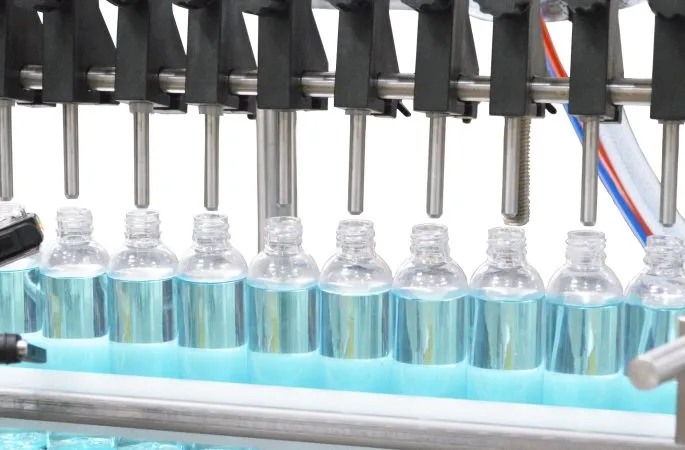
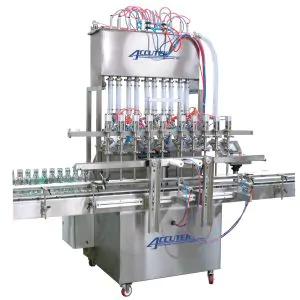
- Timed-Flow Volumetric Pinch Fillers: Highly favored for thin-to-medium viscosity corrosive liquids like household bleach, sanitizers, and dilute acids. A master manifold maintains constant pressure while air-operated heavy-duty pinch valves control individual nozzle fill cycles. Fluid touches only non-metallic heavy-walled elastomer tubing, eliminating internal valves or seals that could corrode.
- Positive Displacement (PD) Pump Fillers with Non-Metallic Pump Heads: Engineered for thick chemical reagents, gelled acids, surfactant concentrates, and corrosive creams. Utilizing all-plastic gear pumps or peristaltic heads, PD fillers maintain extreme volumetric accuracy without mechanical shear.
- Gravity / Pressure Overflow Non-Metallic Fillers: Designed specifically for clear container packaging where a uniform fill-level appearance is essential (such as chemical retail bottles). The overflow nozzles seal against container necks, returning excess liquid and fumes directly back to a sealed HDPE tank, preventing vapor release into the production room.
3. Recommended Corrosive Liquid Filling Machines & System Configurations
Selecting the ideal machinery configuration depends on product viscosity, production rates (BPM - bottles per minute), container shape, and automation depth. Below are our recommended USA-made chemical filling systems engineered by Accutek:
4. Engineering Selection Matrix: Chemical Compatibility vs. Material Specification
To ensure maximum ROI and machine longevity, technical buyers should cross-reference their chemical formulation against the structural and liquid-contact materials detailed in our engineering selection matrix below:
| Chemical / Reagent Type | pH / Concentration | Primary Contact Material | Secondary Seal Material | Recommended Filling Technology | Fume Hood & Purge Requirement |
|---|---|---|---|---|---|
| Hydrochloric Acid (HCl) | pH 0 - 1 (10% - 37%) | Solid HDPE / PVDF | PTFE / Kalrez® | Timed Flow Pinch Valve / Peristaltic | Mandatory Sealed Hood + Scrubber Outlet |
| Sodium Hypochlorite (Bleach) | pH 11 - 13 (5% - 15%) | Polypropylene (PP) / Titanium | Viton® / EPDM | Pressure Overflow / Timed Flow | Recommended Fume Exhaust Interface |
| Sulfuric Acid (H₂SO₄) | pH < 1 (Up to 98%) | PTFE / PVDF / Hastelloy C | PTFE Encapsulated | Positive Displacement / Heavy Duty Piston | Mandatory Enclosed Cabinet + Positive Air |
| Nitric & Phosphoric Acid | pH 1 - 2 (Concentrated) | HDPE / Kynar® | PTFE / FKM | Timed Flow Volumetric | Mandatory Fume Extraction Hood |
| Industrial Caustics (NaOH) | pH 12 - 14 (Up to 50%) | Polypropylene / 316SS (Option) | EPDM / PTFE | Positive Displacement Pump Filler | Standard Ventilation Cabinet |
| Corrosive Solvents & Alcohols | Variable / Flammable | 316L SS / PTFE / Hastelloy | PTFE / Kalrez® | Intrinsically Safe Explosive-Proof (Class 1 Div 1) | NEMA 7/9 Explosion-Proof Purge Enclosures |
Need a Custom Chemical Compatibility Analysis?
Send your SDS (Safety Data Sheet) and container specs to Accutek’s senior engineering team. We will analyze liquid viscosity, vapor pressure, and chemical kinetics to design a tailored non-metallic filling solution.
Inquire Now5. Future Sourcing & Technological Trends in Corrosive Liquid Bottling (2026–2035)
As global environmental compliance tightens and chemical manufacturers adopt Industry 4.0 automation, several pivotal technological shifts are defining the future of corrosive liquid packaging machinery:
Trend 1: Zero-Emission Fume Containment & Integrated Vapor Scrubbing
Regulatory agencies (EPA, EU REACH, and OSHA) are imposing zero-threshold vapor limits for halogenated gases, chlorine fumes, and acid vapors inside manufacturing plants. Next-generation corrosive filling machinery incorporates fully sealed poly-acrylic or polycarbonate glove-box style enclosures operating under constant negative pressure. Integrated fume ports connect directly to localized wet scrubbers or carbon absorption systems, preventing corrosive gas migration into the factory atmosphere.
Trend 2: Smart IoT Corrosion Monitoring & Predictive Maintenance
Modern Accutek systems feature non-contact ultrasonic fluid sensors, optical leakage detectors inside double-walled drip trays, and positive-pressure gas monitoring for PLC electrical cabinets. If vapor pressure drops inside an electrical enclosure or a micro-leak is detected in a delivery line, the machine automatically initiates a safe emergency flush cycle and alerts plant supervisors via industrial IoT protocols (OPC UA / MQTT).
Trend 3: Rapid Toolless Changeover & Modular Plastic Tooling
Chemical contract packers increasingly demand shorter production runs across diverse bottle geometries. Traditional metal change-parts are being superseded by lightweight, color-coded, 3D-printed chemical-grade polymers (such as PETG and UHMW-PE). Operators can change bottle guide rails, neck clamps, and nozzle arrays in under 15 minutes without tools or metallic fasteners that could seize due to acid exposure.
Trend 4: Fully Automated Turnkey Lines with Robotic Container Handling
To complete human isolation from toxic chemicals, procurement officers are moving away from stand-alone fillers toward fully automated, enclosed turnkey lines. Automatic bottle unscramblers feed HDPE containers onto plastic tabletop conveyor chains, where robotic pick-and-place units position containers under filling nozzles, apply non-metallic caps, seal foil induction liners, and apply pressure-sensitive labels without operator exposure.
6. Frequently Asked Questions (FAQ) for Global Chemical Procurement Officers
Below are comprehensive answers to the most critical technical and operational questions asked by plant managers and procurement teams when evaluating Corrosive Liquid Filling Machines:
7. Why Global Chemical Manufacturers Trust Accutek Packaging Equipment
Selecting a packaging equipment manufacturer for hazardous or corrosive applications requires deep technical trust, verified engineering capability, and responsive after-sales support. Here is why industry-leading chemical producers partner with Accutek:
37+ Years of USA Engineering Heritage
Since 1988, Accutek has engineered and manufactured over 78,000 packaging machines from our California headquarters. Our deep institutional knowledge in materials science ensures your corrosive equipment is designed right the first time.
100% Custom Non-Metallic Fabrication
We do not simply apply plastic coatings over steel frames. Accutek builds true non-metallic machinery utilizing solid CNC-machined HDPE, PP, and PVDF structures designed to withstand decades of raw chemical exposure.
Three US Showrooms & Testing Facilities
With facility locations in California, Texas, and Florida, clients can visit our showrooms, observe real equipment trials, perform FAT testing, and collaborate directly with our senior application engineers.
Lifetime Technical Support & Rapid Parts
Chemical bottling lines cannot afford downtime. Accutek maintains an extensive inventory of replacement non-metallic tubing, valves, pinch sleeves, and electronic sensors, backed by factory-trained field service technicians available worldwide.
Ready to Engineer Your Corrosive Liquid Bottling Line?
Speak directly with our senior packaging application specialists. We will guide you through equipment selection, fluid dynamics testing, and provide a comprehensive turnkey proposal tailored to your production throughput.
Visit Our Showrooms Across the USA
View our corrosive packaging machines and turnkey bottling lines in action at any of our three US showroom locations. Our knowledgeable team is ready to demonstrate our equipment and assist with container testing.
2980 Scott St, Vista, CA 92081
8051 Jetstar Dr #175, Irving, TX 75063
14231 Jetport Loop W #1, Fort Myers, FL 33913
Part of a Trusted Family of Companies
