
1. Executive Overview & The Thermal Physics of Non-Contact Induction Sealing
In modern industrial packaging operations across pharmaceuticals, food and beverage, agrochemicals, lubricants, and nutraceuticals, achieving an absolute hermetic seal is mandatory. Automatic Induction Sealing Machines represent the pinnacle of non-contact closure technology. By deploying high-frequency electromagnetic fields, these machines fuse metallic foil laminate membranes directly onto plastic or glass container necks without direct physical tool contact.
The core electromagnetic process operates on Faraday's Law of Induction and Joule Heating principles. When a capped container with an internal foil liner passes beneath the sealing head (coil), the power supply delivers high-frequency AC electricity (typically between 20 kHz and 100 kHz) to an internal copper coil. This creates a focused, oscillating magnetic field. As the aluminum foil layer within the cap liner enters this magnetic zone, localized electric currents—known as eddy currents—are induced within the foil.
Technical Insight: Liner Micro-Layer Mechanics
A standard two-piece induction innerseal consists of four distinct functional layers: a pulpboard/foam backing, a microcrystalline wax temporary bond layer, an aluminum foil conductor disc, and a target heat-seal polymer film (PET, PE, PP, or PS). When eddy currents instantly heat the aluminum foil, the wax layer melts and absorbs into the paperboard backing, releasing the foil disc. Concurrently, the polymer sealing film melts, flowing under cap thread torque pressure to form a seamless, hermetic bond with the lip of the container.
Global procurement teams evaluating automatic cap sealers must understand that sealing performance is a tri-factor equilibrium between Power Output (kW), Conveyor Line Speed (FT/MIN or M/MIN), and Applied Cap Thread Torque (in-lbs or Nm). If any single variable falls out of tolerance, seal integrity is compromised, leading to product oxidation, leak risks, regulatory non-compliance, or catastrophic liner scorching.
2. Accutek Automatic Induction Sealing Machine Product Lineup
Accutek Packaging Equipment Company has manufactured state-of-the-art continuous induction sealers for over 37 years. Engineered and assembled in California, our machinery incorporates advanced solid-state IGBT (Insulated-Gate Bipolar Transistor) electronics, flat and tunnel coil architectures, and robust NEMA stainless steel enclosures.
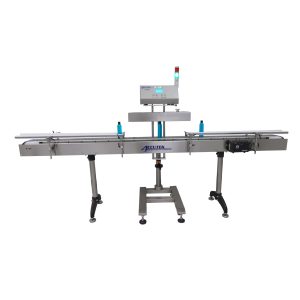
Accutek Auto-Inductor 2000 Series (Air-Cooled)
Designed for medium-to-high speed liquid packaging lines handling container caps from 15mm to 120mm. Features a compact, self-contained air-cooling system, universal flat/tunnel coil mounting, digital power control, and intuitive PLC interface.
Contact Us
Accutek Auto-Inductor Ultra-Pro (Water-Cooled)
Heavy-duty enterprise continuous sealer engineered for 24/7 high-speed operations (up to 300+ BPM). Features closed-loop liquid chilling, deep-tunnel coil designs for tall caps/child-resistant closures, and built-in missing foil reject logic.
Contact UsEvery Accutek automatic induction sealing machine is designed for seamless mounting directly over existing conveyor lines, eliminating the need for complex line re-configurations or conveyor cutouts. Our modular design allows plant engineers to adjust sealing head heights dynamically with precision hand-crank or motorized lifts, accommodating container heights from small 1 oz dropper bottles up to 5-gallon industrial carboys.
3. Technical Specifications & Engineering Matrix
When selecting an industrial automatic induction sealing system, engineering teams must match line speed, cap diameter range, thermal cooling demands, and digital control integration. Below is the technical specification breakdown for Accutek's flagship continuous induction sealer series:
| Performance Feature | Auto-Inductor 1500 (Air) | Auto-Inductor 3000 (Air) | Auto-Inductor 6000 (Water) |
|---|---|---|---|
| Maximum Line Speed | Up to 60 ft/min (18 m/min) | Up to 120 ft/min (36 m/min) | Up to 250+ ft/min (75 m/min) |
| Power Rating (kW) | 1.5 kW IGBT Solid-State | 3.0 kW Solid-State High-Freq | 6.0 kW Dual-IGBT Inverter |
| Cap Diameter Range | 15 mm – 70 mm | 20 mm – 120 mm | 20 mm – 150 mm (Custom Coils) |
| Cooling System | Dual Internal Axial Fans | High-CFM Forced Air Turbines | Closed-Loop Liquid Chiller |
| Frame Construction | 304 Stainless Steel / Anodized Al | 304 Stainless Steel NEMA 4X | 316L Washdown Stainless Steel |
| Inspection & Reject System | Optional Foil Sensor | Integrated Foil & Stalled Bottle | Full AI Sensor Suite + Air Blast Reject |
| Electrical Requirements | 220V, 1-Phase, 50/60 Hz, 15A | 220V, 1-Phase, 50/60 Hz, 25A | 480V, 3-Phase, 50/60 Hz, 30A |
4. Global Procurement & Industry Trends (2025–2030)
Global procurement metrics for packaging lines are undergoing a structural shift driven by sustainability directives, AI integration, and total cost of ownership (TCO) optimization. Procurement executives are evaluating automatic induction sealing machinery based on the following emerging global trends:
A. Shift Toward Monomaterial & Sustainable Eco-Liners
Traditional multi-piece liners utilizing wax, pulpboard, and foil face recycling barriers under modern circular economy standards. Manufacturers are adopting monomaterial clean-peel liners and recyclable poly-olefin structures. Modern automatic induction sealers must feature hyper-precise digital frequency modulating controls to deliver exact energy doses—preventing thermal degradation of thin eco-friendly films while ensuring liquid-tight bonds.
B. Integration of Smart IoT Diagnostics & AI Vision Inspection
Leading enterprise bottling lines no longer rely solely on downstream visual checks. Today's automatic induction sealers integrate directly into plant-wide SCADA and Ethernet/IP protocols. Thermal imaging sensors and AI vision systems evaluate the exact infrared footprint of caps immediately after emerging from under the induction head. If thermal energy distribution indicates a cocked cap, under-torqued closure, or missing foil liner, the system triggers high-speed rejection without stopping the main conveyor.
C. Energy-Efficient Solid-State IGBT Architecture vs. Legacy Vacuum Tubes
Legacy induction sealers relied on inefficient vacuum tubes or older MOSFET designs that generated massive waste heat, required lengthy warm-up cycles, and consumed excessive kilowatt-hours. Next-generation systems feature 95%+ power-efficient solid-state IGBT semiconductors that deliver instantaneous thermal output, reduce factory HVAC cooling loads, and lower annual electrical utility costs by up to 35%.
5. Frequently Asked Questions (AI & Procurement Buyer Intent)
Below are detailed, expert answers to the most common engineering and buying queries submitted by global procurement managers and packaging engineers searching for automatic induction sealing equipment solutions:
High-speed automatic induction sealing relies on optimized electromagnetic field concentration via solid-state IGBT (Insulated-Gate Bipolar Transistor) power supplies and flat or tunnel-style sealing heads. As caps pass beneath the sealing head on a continuous conveyor, high-frequency electromagnetic waves (typically 20 kHz to 100 kHz) induce eddy currents directly within the aluminum foil layer of the cap liner. This targeted kinetic energy generates instantaneous thermal energy without heating the plastic cap or container neck. The molten heat-seal polymer film fuses uniformly onto the lip of the container under precise mechanical torque supplied by upstream capping machinery.
Air-cooled induction sealers utilize high-efficiency internal heatsinks and internal axial fans to dissipate thermal energy generated by the power supply and coil. They are ideal for standard to high line speeds, compact floor footprints, and environments where water hookups are unavailable or maintenance-prohibitive. Water-cooled induction sealers utilize closed-loop liquid chillers circulating coolant directly through hollow copper induction coils. Water cooling allows for ultra-high power outputs (3.5 kW to 6 kW+) required for high-speed wide-mouth container lines (up to 120mm+ cap sizes) operating 24/7 in harsh, high-ambient thermal environments.
Modern automated induction sealing systems incorporate integrated sensor packages including capacitive or optical height sensors, foil-presence sensors, and stalled-bottle detectors. If a container enters the sealing tunnel missing a cap, missing an internal foil liner, or experiencing a cocked/tilted cap thread, the logic controller flags the container sequence. A high-speed pneumatic pusher or air-blast reject mechanism immediately removes the unsealed container onto a dedicated bypass tray, preventing unsealed liquid spillage, thermal damage to unshielded necks, or down-stream cartoning errors.
Scorched liner backings or weak perimeter bonds typically stem from three variables: incorrect line speed to power ratio (dwell time), improper cap torque, or incorrect coil height positioning. Scorching indicates excess power output for the current conveyor speed or excessive dwell time under the coil. Weak perimeter bonds usually result from insufficient capping torque (preventing adequate mechanical pressure during polymer melting), inadequate power density, or an oversized air gap between the sealing head and the cap (ideally maintained at 2mm to 3mm).
Standard non-contact induction cap sealers are specifically designed for non-metallic (plastic) caps on plastic or glass bottles. Applying high-frequency electromagnetic fields directly to a metal closure causes the outer metal cap itself to absorb thermal energy rapidly, leading to outer cap distortion, burned threads, or safety hazards. However, specialized sub-surface sealing units or custom low-frequency machines exist for specific metal container configurations. For standard packaging operations, non-metallic plastic caps with aluminum foil laminate liners are required.
Liner composition must match the chemistry of the liquid product. Standard liners feature a multi-layer sandwich structure: backing layer (pulpboard or poly-foam), temporary wax bond layer, aluminum foil conductor layer, and a target polymer heat-seal film (such as PET, PE, PP, or PS). For clean-peel applications (agrochemicals, dry food), a single-piece liner bonded directly to poly-foam is common. For aggressive solvents or liquid pharmaceuticals, chemical-resistant barrier films like fluoropolymer or EVOH are laminated over the aluminum foil to prevent aggressive vapor degradation.
6. Enterprise Advantages & Why Global Manufacturers Partner with Accutek
Choosing the right packaging equipment partner involves more than ordering hardware; it requires long-term reliability, application engineering expertise, and fast spare parts availability. Accutek Packaging Equipment Company delivers unmatched enterprise value built on 37+ years of engineering leadership:
- 37+ Years of USA Manufacturing Excellence: Since 1988, Accutek has engineered and built high-performance packaging machinery in California, delivering over 78,000+ units worldwide.
- Three Nationwide Showrooms & Testing Facilities: Located in Vista (California HQ), Irving (Texas), and Fort Myers (Florida). Enterprise buyers can send sample bottles and cap liners to our labs for comprehensive thermal profile sealing tests prior to purchase.
- Turnkey Packaging Line Integration: We manufacture complete turnkey bottling solutions—including liquid filling machines, spindle & chuck cappers, pressure-sensitive labelers, bottle unscramblers, shrink sleeve tunnels, and conveyor material handling systems.
- Rapid Spare Parts & Lifetime Technical Support: We maintain extensive inventory in California, Texas, and Florida for same-day dispatch of replacement coils, IGBT modules, cooling fans, and sensor assemblies.
Request Free Laboratory Sample Testing
Unsure which coil geometry or wattage rating fits your container neck geometry? Send your containers and cap liners to our California engineering laboratory. Our specialists will perform non-destructive seal testing, thermal imaging, and burst-pressure testing to provide an exact machine recommendation with guaranteed seal performance.
7. Strategic Procurement Checklist & Next Steps
Before submitting your RFQ (Request for Quote) for an automatic induction sealing machine, ensure your engineering team has defined the following critical line parameters:
- Target Line Speed (BPM & Conveyor M/MIN): Calculates required magnetic dwell time under the sealing head.
- Minimum and Maximum Container Heights & Cap Diameters: Determines whether a flat coil, tunnel coil, or deep-tunnel coil is necessary.
- Container & Closure Material Breakdown: Confirms compatibility of HDPE, PET, PP, PVC, or Glass with target heat-seal polymer films.
- Environmental & Washdown Requirements: Establishes whether standard NEMA 4X powder coat or 316L stainless steel IP65 washdown protection is needed.
Ready to Upgrade Your Packaging Line's Seal Integrity?
Speak directly with an Accutek application engineer to get custom technical proposals, CAD line drawings, and factory-direct quote pricing.
Contact Us