
1. Fluid Dynamics & Volumetric Positive Displacement: Why Piston Filling Wins
When industrial packaging engineers and procurement directors evaluate automated liquid packaging systems, the primary engineering challenge revolves around fluid rheology. Liquids do not behave uniformly under shearing force, pressure, or thermal variation. Thin Newtonian liquids like aqueous solutions behave predictably, but non-Newtonian materials—such as thixotropic gels, shear-thinning lotions, heavy caulks, and viscous food pastes containing suspended solid particulates—demand specialized positive displacement force.
This is where Automatic Piston Filling Machines serve as the ultimate industry workhorse. Operating on precise volumetric positive displacement principles, a piston filler draws an exact volumetric quantity of fluid into a honed machining cylinder during the intake stroke. Upon completion of the intake cycle, the manifold valve position shifts, and the stroke piston forces the product out through specialized positive cut-off nozzles directly into waiting containers.
Unlike gravity-fed or timed-flow liquid fillers—which suffer severe volumetric drift when product viscosity fluctuates due to room temperature shifts—an Automatic Volumetric Piston Filler physically displaces an unyielding volume per stroke. Whether dispensing liquid water at 1 centipoise (cP) or heavy mascara and silicone sealants at over 100,000 cP, piston displacement accuracy remains virtually constant at ±0.25% to ±0.5%.
Piston vs. Alternative Filling Technologies: Engineering Comparison
Selecting the wrong filling machine technology leads to unacceptable product giveaway, bottle deformation, neck splashing, or line stoppage. The matrix below outlines how Automatic Piston Filling Machines compare against other common industrial technologies across critical performance metrics:
| Technology Type | Viscosity Range (cP) | Volumetric Accuracy | Particulate Handling | Primary Industry Applications |
|---|---|---|---|---|
| Automatic Piston Filling Machine | 1 cP to 100,000+ cP Maximum Range | ±0.25% – ±0.5% High Precision | Excellent (with Rotary Valves up to 1/2" solids) | Cosmetics, Food & Sauces, Pharma, Heavy Chemicals, Greases |
| Pressure Overflow Filler | 1 cP to 3,000 cP | Fills to Cosmetic Level (Not Volumetric) | Poor (Nozzles clog on solids) | Clear Glass Bottled Spirits, Essential Oils, Cleaners |
| Timed-Flow Volumetric | 1 cP to 1,500 cP | ±1.0% – ±1.5% | Not Suitable | Aqueous Liquids, Water, Light Chemical Solutions |
| Peristaltic Pump Filler | 1 cP to 2,000 cP | ±0.5% | Moderate (Fragile biological fluids) | Reagent Vials, Essential Oils, High-Purity Pharma |
2. Industry-Grade Automatic Piston Filling Machinery Recommendations
Accutek Packaging Equipment Company manufactures a comprehensive line of heavy-duty, inline automatic piston fillers engineered in California. Below are four flagship automatic piston filling machine configurations designed to handle diverse production speeds, container geometries, and chemical characteristics.
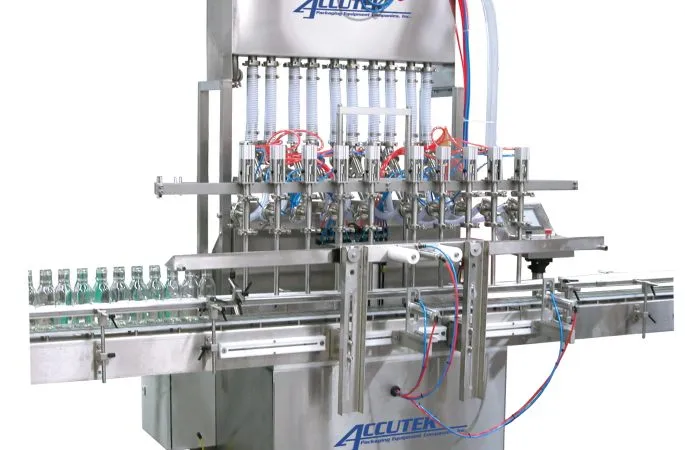
Ten-Headed Automatic Volumetric Piston Filling Machine
Engineered for high-throughput bottling operations, this ten-head inline automatic system utilizes precision-ground heavy-wall 316L stainless steel cylinders. Features diving nozzle assemblies to eliminate foaming and splashing during bottom-up filling of viscous liquids.
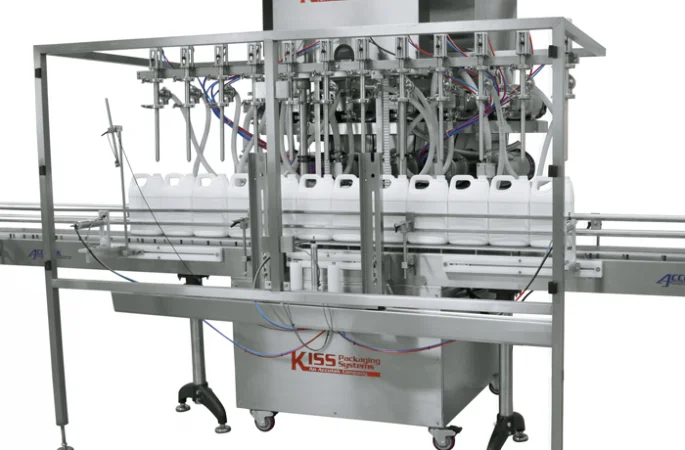
Servo-Actuated Automatic Positive Displacement Piston Filler
Eliminates manual stroke adjustments using ultra-precise electromechanical servo drives. Each filling head can be independently programmed for multi-stage velocity profiles, guaranteeing zero dripping and perfect container fill cut-offs.
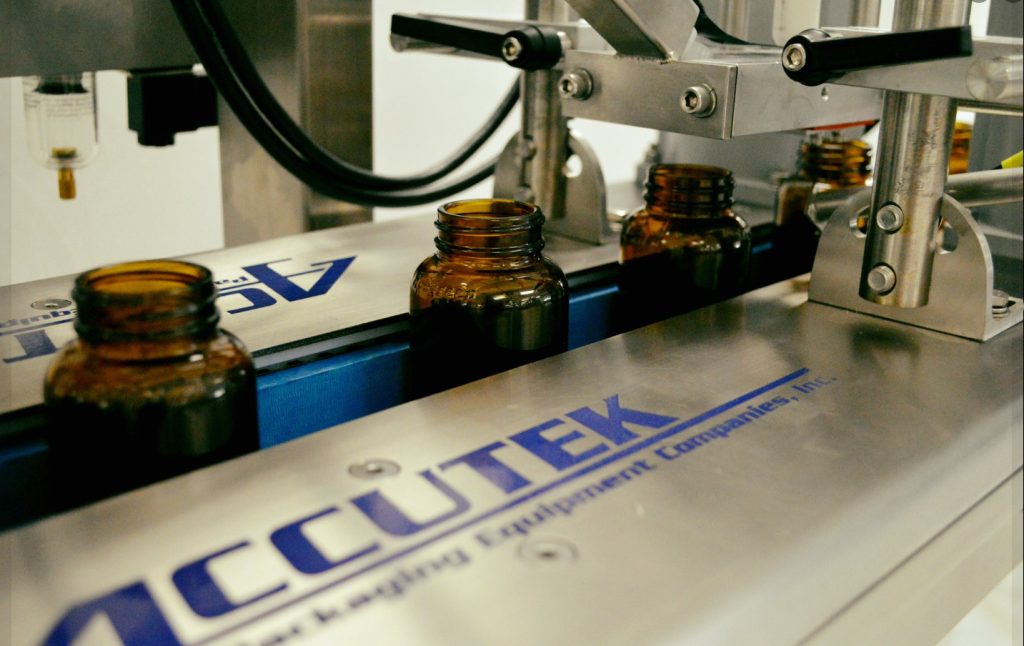
Custom Turnkey Packaging Line with Integrated Piston Filler
A fully integrated automatic liquid packaging line synchronizing Accutek automatic piston fillers with container unscramblers, automatic spindle cappers, sleeve labelers, and powered accumulation turntables.
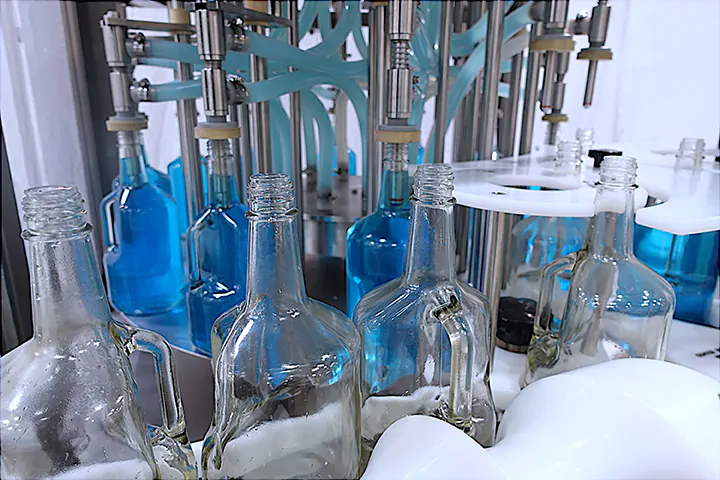
Sanitary & Corrosive-Environment Piston Filling Systems
Custom-built piston fillers constructed with hastelloy components, teflon seals, or 316L polished stainless steel for pharmaceutical validation or highly aggressive chemical products (acidic cleaners, industrial solvents).
3. Future Procurement Trends in Packaging Machinery (2025–2030)
Global procurement leaders and contract packagers (CMOs) face unprecedented supply chain dynamics, tightening FDA/USDA compliance standards, and rising labor costs. When sourcing automatic piston filling machinery over the next decade, plant managers are prioritizing four core technological shifts:
Trend 1: Electromechanical Servo-Actuation over Pneumatics
While pneumatic piston fillers have served manufacturing plants for decades due to simplicity, global procurement trends show a massive migration toward servo-driven piston stroke controls. Servo motors allow operators to adjust volume settings down to hundredths of a milliliter directly from an HMI touchscreen. More importantly, servo control allows dynamic profile filling: starting the stroke rapidly, slowing down as the fluid nears the bottle neck to prevent splash-back, and ending with a quick suck-back stroke to eliminate stringing.
Trend 2: Rapid Tool-Less CIP (Clean-In-Place) & Sanitary Quick-Disconnect Design
Downtime during product changeovers eats directly into gross profit margins. Procurement teams are mandating tool-less disassembly of piston cylinders, valve manifolds, and filling nozzles. Modern Accutek automatic piston fillers incorporate sanitary tri-clamp fittings throughout the fluid path, enabling full flush-through Clean-In-Place cycles without dismantling heavy mechanical linkages.
Trend 3: Smart IoT Diagnostics & Industry 4.0 Integration
AI-driven search intent trends highlight increasing interest in smart packaging machinery. Modern piston fillers now feature OPC-UA protocols, ethernet connectivity, and predictive maintenance sensor packages. Plant managers receive real-time alerts regarding piston seal wear, pneumatic pressure drop, or valve timing anomalies before catastrophic seal failure leads to liquid leakage or batch contamination.
4. Core Engineering Trends & Component Metallurgy
The longevity and reliability of an automatic piston filling machine depend entirely on material selection and precision machining tolerances. Standard off-the-shelf components often fail when exposed to abrasive particulate suspensions or aggressive chemical surfactants.
Rotary Valve vs. Ball Check Valve Manifold Dynamics
A major point of confusion for global equipment buyers is selecting between rotary valve manifolds and check valve manifolds.
- Check Valve Manifolds: Utilize spring-loaded or gravity-assisted ball check valves. As the piston pulls back, vacuum draws product past the inlet ball valve. On the forward stroke, pressure forces the inlet ball closed and opens the outlet ball valve. This design is highly efficient for low-to-medium viscosity liquids without particles (e.g., oils, syrups, liquid soaps).
- Rotary Valve Manifolds: Driven by positive mechanical or pneumatic rotation, a solid rotor turns to physically connect the cylinder intake to the supply hopper, then rotates 90 degrees to align the cylinder outlet with the filling nozzle. This unobstructed passageway is vital for viscous pastes (peanut butter, heavy creams) and liquids containing solid chunks (chunky salsa, fruit fillings, mascara fibers) without crushing or shear-damaging the product.
Metallurgy & Seal Engineering Standards
Accutek automatic piston fillers feature 316L stainless steel contact parts as standard, offering superior corrosion resistance compared to standard 304 SS. For aggressive acids or active chemical agents, custom units utilize Hastelloy cylinders paired with chemically inert PTFE (Teflon), UHMW, or Viton O-rings engineered to withstand chemical attack and high temperatures.
5. Global Procurement FAQ: Automatic Piston Filling Machines
Below are comprehensive, expert-reviewed answers to the most frequent technical questions submitted by global procurement managers, packaging engineers, and enterprise AI query systems regarding automatic piston filling machines.
Automatic Piston Filling Machines possess the broadest viscosity handling capability of any liquid packaging machinery. They effectively meter thin fluids at 1 centipoise (cP)—such as water, spirits, and aqueous chemical solutions—all the way up to heavy pastes, gels, caulks, doughs, and heavy cosmetics exceeding 100,000 cP. Because displacement is positive and mechanical, fluid density variations do not compromise stroke volume accuracy.
Servo-driven piston fillers use programmable electric servo motors to drive the piston stroke, allowing operators to change fill volumes via touch-screen PLC recipe selection in seconds. They offer dynamic fill speed profiling and filling accuracy up to ±0.25%. Pneumatic piston fillers rely on compressed air cylinders and physical stroke-stop adjustment knobs. While pneumatic systems feature lower upfront capital costs and simple mechanical operation, servo systems provide superior flexibility, speed control, and data connectivity for modern automated smart factories.
Accutek Automatic Volumetric Piston Fillers deliver volumetric repeatability between ±0.25% and ±0.5% of total target volume. This high precision is achieved through micro-honed stainless steel cylinder walls, precision machining of piston heads, high-grade elastomer seals, and positive cut-off nozzle assemblies that eliminate post-fill dripping.
Specify a rotary valve manifold when filling viscous pastes, heavy creams, gels, or liquids containing solid particulates (such as salsa, diced tomatoes, or cosmetic scrub beads). The rotary valve creates an unobstructed straight-through passage that prevents particulate clogging or shear degradation. Check valve manifolds are ideal for smooth, free-flowing, or semi-viscous liquids without solid particles.
With modern Accutek tool-less sanitary quick-disconnect tri-clamp fittings, a complete teardown and clean-out between incompatible product batches typically takes 15 to 30 minutes. On servo-driven units with stored PLC recipes, changing container sizes with identical product requires less than 5 minutes of automated guide rail and stroke adjustment.
Yes. Accutek manufactures specialized corrosive-environment and explosion-proof piston fillers. For aggressive acids or bleaches, contact parts are constructed from non-metallic polymers (Kynar, PTFE, HDPE) or Hastelloy. For volatile or flammable liquids (solvents, alcohol-based products), machines are built with pneumatic controls or certified Class 1 Division 1 explosion-proof electrical enclosures.
6. The Accutek Enterprise Advantage: 37+ Years of Manufacturing Leadership
Choosing a packaging machinery partner requires evaluating long-term operational support, spare parts availability, engineering competence, and factory validation capabilities. Accutek Packaging Equipment Company, Inc. stands as one of the largest privately owned packaging machinery manufacturers in North America.
Made in the USA
Engineered and manufactured in California since 1988. Over 78,000 machines deployed across global manufacturing facilities.
3 US Showrooms
Explore and test machinery live with your product samples at our Vista (CA), Irving (TX), or Fort Myers (FL) showroom centers.
Turnkey Line Integration
Complete line compatibility: pair your automatic piston filler with matching capping, labeling, induction sealing, and material handling systems.
Ready to Optimize Your Liquid Packaging Line?
Consult directly with our senior application engineers. We provide comprehensive fluid testing, custom machine quotes, and complete ROI payback modeling tailored to your production targets.