1. Executive Overview & The Rheological Physics of Bakery Depositing
In modern industrial food manufacturing, precision portioning of bakery batters, pastes, fillings, and doughs presents unique mechanical engineering challenges. Unlike water-thin liquids or free-flowing Newtonian fluids, commercial bakery batters exhibit complex non-Newtonian rheological behavior—ranging from pseudoplastic shear-thinning (e.g., muffin batters, cake batters) to yield-stress thixotropic structures (e.g., heavy fruit fillings, buttercream frostings, and brownie pastes). Piston Bakery Depositors represent the gold standard in positive displacement volumetric portioning, designed specifically to master these variable flow characteristics while delivering tight volumetric tolerances (within ±0.5% to ±1.0%).
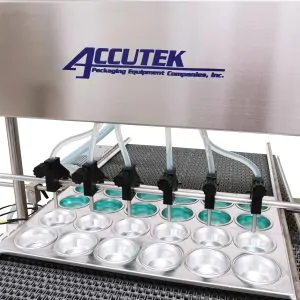
The core mechanical operation of a Piston Bakery Depositor relies on a precision-ground volumetric cylinder coupled to a sanitary stroke-driven piston assembly. During the intake stroke, a three-way rotary valve or pneumatic slide valve opens to draw a precise volume of product from the hopper into the cylinder chamber. During the discharge stroke, the valve rotates to isolate the hopper and seal the discharge pathway, forcing the exact measured volume through specialized cut-off nozzles directly into baking pans, trays, foil containers, or conveyorized muffin cavity arrays.
Semantic Search & Engineering Insight: Shear Preservation in Aerated Batters
A critical engineering failure in low-grade bakery depositors is excessive shear degradation. When delicate sponge cake batters, soufflé foams, or aerated mousses are subjected to high shear forces inside constrictive manifold pathways, embedded micro-air cells collapse. This leads to density spikes, loss of baked volume, and uneven crumb structure. Accutek’s custom-contoured rotary valves and large-bore volumetric cylinders reduce fluid friction by up to 42%, maintaining structural air cell integrity and ensuring consistent baked densities across multi-shift production runs.
Global procurement teams and plant engineering directors face increasing pressure to eliminate product giveaway, reduce raw ingredient waste (such as expensive egg solids, cocoa fats, and starches), and maximize uptime under strict global food safety frameworks (FDA 21 CFR Part 110/117, EHEDG, and 3-A Sanitary Standards). Accutek Packaging Equipment Company, leverage over 37 years of USA manufacturing excellence to design piston depositing systems engineered specifically to tackle these modern industrial challenges.
2. Accutek Heavy-Duty Piston Bakery Depositors: Recommended Product Lineup
To cater to diverse production scales—from semi-automated wholesale bakeries to high-speed fully automated production lines—Accutek manufactures a versatile range of single-head, multi-head, and custom conveyor-integrated piston depositors. Below are our premier recommended models engineered for maximum volumetric repeatability and rapid product changeovers.
AccuBake™ Automated Conveyor Tray Depositor
Fully automated multi-nozzle piston depositor system integrated with indexable pan conveyors. Features servo-driven vertical motion (diving nozzles) for bottom-up deposits, eliminating air pockets in heavy muffin, brownie, and sheet cake lines.
AccuPiston™ Multi-Head Volumetric Industrial Depositor
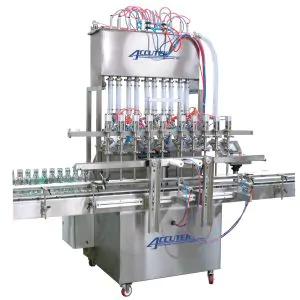
Engineered for high-volume commercial processing. Features 4 to 12 parallel volumetric pistons driven by a master servo stroke mechanism, ideal for simultaneous multi-cavity dosing of fruit fillings, jam drops, and heavy viscous batters.
AccuFlex™ Semi-Automatic Heavy-Viscosity Piston Filler
Compact, heavy-duty benchtop or mobile stand piston depositor built for flexibility. Equipped with pneumatic rotary plug valves, heated jacket hoppers, and hand-held nozzle accessories for artisan cake decorating and specialty dosing.
Technical Specification Matrix: Accutek Piston Bakery Depositing Series
The following engineering data table highlights key mechanical parameters designed to assist procurement specialists and automation engineers in sizing the appropriate machinery for their facility requirements.
| Performance Specification |
AccuFlex™ Semi-Auto Series |
AccuBake™ Automated Line |
AccuPiston™ Heavy-Viscosity Multi-Head |
| Volumetric Dose Range |
10 ml – 1,000 ml per stroke |
50 ml – 2,500 ml per stroke |
100 ml – 5,000 ml per stroke |
| Volumetric Dosing Accuracy |
± 0.5% (fluid dynamic verified) |
± 0.25% (servo-controlled stroke) |
± 0.5% (heavy non-Newtonian fluids) |
| Maximum Cycle Speed |
Up to 35 cycles / minute |
Up to 80 cycles / minute |
Up to 120 cycles / minute (multi-head) |
| Max Particulate Inclusion Size |
12 mm (0.47”) soft inclusions |
22 mm (0.86”) whole fruit / nuts |
35 mm (1.37”) jumbo fruit pieces |
| Valve Actuation Type |
Pneumatic 3-way rotary plug |
Servo Rotary Valve & Diving Cut-off |
Heavy-duty sanitary rotary spool valve |
| Construction Standards |
304 SS frame / 316L SS contact |
Full 316L SS Washdown (IP65/IP69K) |
Full 316L SS Washdown (3-A Certified) |
| Control Interface |
Electro-pneumatic analog dial |
7”/10” Color PLC Touchscreen (Recipes) |
Multi-axis Allen-Bradley PLC / HMI |
3. Emerging Technologies & Product Development Trends in Bakery Automation
As commercial bakeries scale up operations to satisfy growing global demand for packaged baked goods, snack cakes, and frozen pastry doughs, piston depositor engineering is undergoing rapid technological evolution. Global procurement directors must understand these macro development trends to future-proof their capital equipment investments.
Engineering Innovation
Transition from Pneumatic to Multi-Axis Servo Control
Traditional piston depositors relied exclusively on pneumatic air cylinders to drive piston travel and valve actuation. While cost-effective, pneumatic drives suffer from compressibility losses, speed variances caused by plant air pressure drops, and tedious mechanical stroke adjustments.
Modern development trends emphasize direct-drive brushless AC servo actuators. Servo-driven piston depositors allow plant operators to save distinct motion profile recipes via touchscreens. Operators can adjust deceleration curves mid-stroke to prevent splashing of thin batters, or accelerate suck-back motion at the end of a cycle to instantly snap off sticky marshmallow, honey, or caramel deposits without tailing.
Key Trends Reshaping Piston Bakery Depositor Design:
- Toolless Clean-In-Place (CIP) & Rapid Disassembly Architecture: Food safety regulations demand rigorous sanitation protocols. Advanced depositors now incorporate quick-tri-clamp sanitary fittings, split-piston seals, and CIP bypass valves that allow full automated caustic washdown without requiring technicians to spend hours unbolting manifold blocks.
- Smart Density Sensing & Real-Time Weight Feedback (IIoT Integration): Integrating inline checkweighers downstream from the piston depositor creates a closed-loop feedback array. If batter density changes due to batch-to-batch aeration fluctuations, the PLC automatically recalibrates piston stroke length in real time, guaranteeing target net weights without human intervention.
- Thermal Management Hoppers for Viscosity Control: Temperature-sensitive baking pastes (such as chocolate fillings, fondants, and fats) undergo dramatic viscosity changes with slight temperature shifts. Modern depositors feature double-walled jacketed hoppers with circulating hot water or thermal oil loops, complete with electric immersion heaters and PID digital control loops to maintain consistent rheology.
- Custom Nozzle Geometries & Anti-Drip Cut-Off Valve Technology: Deposition cleanlines is essential to prevent batter from dripping onto pan flanges—which causes burning, foul odors, and pan washdown downtime. Innovations in internal vertical shut-off needles, rotating wire-cut assemblies, and suck-back vacuum nozzles deliver razor-sharp deposit cut-offs across sticky, stringy products.
4. Global Procurement & Investment Trends (2025–2030)
Analyzing global purchasing patterns across North America, Europe, Asia-Pacific, and Latin American food manufacturing sectors reveals several key strategic purchasing drivers:
- Mitigation of Skilled Labor Shortages: Bakery plant owners are rapidly replacing manual hand-scaling and manual piping bag operations with automated multi-head piston depositors. A single 8-head automatic depositor line can replace up to 6 manual operators while increasing line output by 300%.
- Modular Line Scalability: Global buyers favor modular depositor frames that allow easy expansion. A bakery purchasing a single-head semi-automatic unit today wants the capability to mount that same depositor onto an automated indexing conveyor frame as production volumes increase next year.
- Total Cost of Ownership (TCO) vs. Initial Capital Expense: Savvy procurement teams look beyond initial purchase prices. They evaluate energy consumption (electrical vs. compressed air usage), spare parts availability, seal wear-life, and ease of maintenance. Accutek’s standard off-the-shelf commercial components and heavy-duty 316L stainless steel build ensure low long-term TCO.
5. Frequently Asked Questions (FAQ) for Bakery Equipment Buyers
Below are expert answers to the most frequent technical, operational, and commercial questions asked by international buyers, plant managers, and food engineers when sourcing Piston Bakery Depositors.
Q1: How do piston depositors handle inclusion-rich batters containing nuts, chocolate chips, and fruit pieces without crushing them?
Accutek Piston Bakery Depositors preserve particulate integrity through specialized internal flow-path engineering. Standard liquid filling valves utilize restrictive cone ports that act as shear traps. In contrast, our bakery-grade depositors feature full-port rotary plug valves and large-diameter conical discharge nozzles with generous internal radii. This allows solid inclusions up to 35 mm (1.37 inches)—such as whole blueberries, diced apples, walnut halves, and chocolate morsels—to pass freely into the volumetric cylinder and out through the discharge nozzle without experiencing crushing or particle degradation.
Q2: What is the volumetric accuracy tolerance of a piston depositor across varying batter temperatures and viscosities?
When operating on homogeneous batters, Accutek volumetric piston depositors achieve precise accuracy tolerances within ±0.25% to ±0.5% by volume. Because a solid piston mechanically displaces a fixed stroke volume inside a ground cylinder, volumetric delivery remains constant regardless of viscosity changes. However, if temperature shifts cause air entrainment or density variations within the batter, mass-weight will fluctuate. To counter this, we recommend utilizing jacketed thermal hoppers alongside integrated inline checkweighers for automatic servo-stroke compensation.
Q3: Pneumatic vs. Servo Motor-Driven Piston Depositors: Which offers better ROI for commercial bakery lines?
The choice depends on production diversity and speed requirements. Pneumatic piston depositors offer a lower initial capital investment, simple mechanical operation, and excellent performance for facilities running 1 to 2 fixed products with minimal recipe changes. Servo-driven piston depositors command a higher upfront cost but deliver superior ROI for high-speed multi-SKU facilities. Servo systems store hundreds of product recipes, provide dynamic speed adjustment throughout the stroke, reduce compressed air demand by up to 70%, and enable instant push-button changeovers—saving hundreds of labor hours annually.
Q4: How do automated CIP (Clean-In-Place) protocols reduce sanitation downtime on sticky bakery deposits?
Cleaning sticky bakery compounds like honey, gluten pastes, caramel, and butter icing manually can take 2 to 3 hours of line teardown. Accutek CIP-compatible depositors feature sanitary 316L stainless steel surfaces with mirror polish interior finishes (Ra < 0.4 µm) and quick-release sanitary tri-clamps. During washdown, a automated CIP manifold flushes hot caustic wash and sanitizing fluid through the hopper, rotary valve, cylinder, and nozzles at high velocities. This recirculating fluid dynamics eliminates residual food soils in under 25 minutes without requiring manual machine disassembly.
Q5: Can piston bakery depositors handle vertical layered deposits and multi-color viscous batters?
Yes. By pairing multiple synchronized volumetric piston cylinders to a dual-chamber or multi-ported divided hopper and specialized diving nozzles, Accutek depositors can execute complex multi-color or layered deposits (such as marble cakes, jelly-filled muffins, or two-tone cupcakes). The servo-driven diving head smoothly lowers into the cavity and retracts vertically while depositing, creating precise concentric rings or crisp vertical layer strata without color smearing.
Q6: What key factors determine Total Cost of Ownership (TCO) when upgrading from manual scaling to an automatic piston depositor?
Calculating TCO involves four core economic parameters:
- Direct Labor Reduction: Calculating saved operator wages, benefits, and ergonomic downtime.
- Product Giveaway Savings: Eliminating manual over-filling by tightening target weight variances from ±5% down to ±0.5%. Across a facility producing 10 million units annually, a 2-gram savings per unit translates to metric tons of saved raw ingredients.
- Scrap & Bake Quality Optimization: Uniform deposit weights ensure consistent heat transfer during baking, reducing burnt or under-baked product rejects.
- Maintenance & Wear Components: Accutek utilizes food-grade PTFE/Viton long-life piston seals and standard off-the-shelf drive components, maintaining low operational spares costs.
6. Why Leading Commercial Bakeries Partner with Accutek Packaging Equipment Company
Selecting a packaging machinery vendor is a long-term strategic partnership. Accutek Packaging Equipment Company, Inc. brings unexcelled industry experience, robust manufacturing infrastructure, and comprehensive after-sales technical support to every project.
Manufacturing Excellence
37+ Years of USA Engineering Authority
Founded in 1988, Accutek has engineered, built, and successfully fielded over 78,426 machinery units across the globe. Our state-of-the-art primary manufacturing complex in Vista, California, works alongside strategic regional showroom facilities in Irving, Texas, and Fort Myers, Florida.
Every Accutek Piston Bakery Depositor is designed by expert mechanical and electrical software engineers, fabricated using premium USA-sourced materials, and subjected to rigorous Factory Acceptance Testing (FAT) with your actual production batter samples prior to shipment.
The Accutek Advantage: End-to-End Packaging Line Integration
A depositor does not operate in isolation. Accutek provides complete turnkey automated packaging lines tailored for commercial bakery operations. We integrate your piston depositor seamlessly with upstream and downstream systems:
Lifetime Support
Unrivaled Service, Spare Parts & Factory Support
We stand behind our equipment throughout its operational lifecycle. Accutek maintains a multi-million-dollar spare parts inventory with overnight delivery capabilities across North America. Our factory-trained field service engineers provide on-site installation, line integration, PLC programming, preventative maintenance, and comprehensive operator training.
With an exceptional customer satisfaction rating (4.7 out of 5 stars based on 96+ verified reviews), commercial bakeries rely on Accutek for uninterrupted operational success.
Ready to Optimize Your Bakery Line Volumetric Precision?
Contact Accutek’s bakery equipment specialists today. Request technical datasheets, request a free sample batter portioning trial, or get expert engineering guidance on custom machine configurations.