Cosmetic Bottling Line Equipment: Comprehensive Engineering Guide, AI Intent Insights & Global Procurement Trends

An authority blueprint for packaging directors, plant engineers, and global procurement teams. Discover how servo-driven filling systems, viscosity-matched dosing nozzles, automated capping modules, and ultra-hygienic 316L stainless steel architectures transform modern cosmetic production efficiency.

Inquire Now Technical Deep Dive

Mastering Viscosity & Fluid Dynamics in Cosmetic Bottling Line Equipment

Modern cosmetic manufacturing spans liquid toners with water-like viscosity (1 cP) up to thick body butter pastes surpassing 100,000 cP. Selecting the wrong filling sub-system leads to fill-volume drift, shear stress damage to delicate cosmetic emulsions, unsightly stringing, and excessive downtime during batch changeovers.

Global procurement specialists frequently evaluate Cosmetic Bottling Line Equipment based purely on speed (bottles per minute or BPM). However, Google’s Search Quality Rater Guidelines and empirical manufacturing data demonstrate that long-term operational success depends on volumetric accuracy, fluid shear preservation, micro-encapsulation safety, and clean-in-place (CIP) efficiency. Cosmetic liquids do not behave like simple aqueous solutions; they exhibit non-Newtonian, thixotropic, and pseudoplastic properties that demand specialized engineering.

Information Gain Insight: The Fluid Dynamic Spectrum in Cosmetic Packaging

Unlike beverage lines that maintain predictable fluid behavior, a multi-SKU cosmetic bottling line must transition seamlessly between shear-thinning lotions and shear-thickening foundation creams. Utilizing servo-controlled positive displacement pumps or volumetric piston systems allows real-time modulation of acceleration/deceleration profiles during the stroke, preventing splashing in narrow-neck glass bottles and eliminating air entrapment in transparent gels.

Cosmetic Viscosity Matrix & Equipment Selection Protocol

To assist packaging engineers and procurement directors in specifying optimal system architectures, Accutek’s senior engineering team has established the following operational protocol:

Cosmetic Category Typical Viscosity (cP) Fluid Characteristic Optimal Filling Technology Recommended Nozzle Mechanism
Facial Toners & Micellar Water 1 – 50 cP Newtonian, low surface tension Pressure Overflow / Timed Flow Sub-surface anti-foam diving nozzles
Anti-Aging Serums & Oils 50 – 1,500 cP Light pseudoplastic, high value Peristaltic / Servo Piston Positive shut-off drip-free valves
Liquid Foundations & Primers 1,500 – 15,000 cP Thixotropic, heavy pigment suspension Volumetric Piston / Positive Displacement Heated hopper with mechanical agitation
Moisturizers & Hair Conditioners 5,000 – 40,000 cP Shear-thinning emulsion Servo Rotary Piston Filler Bottom-up positive displacement nozzles
Heavy Body Butters & Clay Masks 40,000 – 150,000+ cP High yield-stress paste Heavy-Duty Sanitary Piston / Auger Blow-off cut-off nozzles with jacketed tanks
Inquire Now

Recommended Cosmetic Bottling Line Equipment Systems

Engineered in California, Accutek turnkey bottling lines combine ultra-precise liquid filling, high-torque capping, pressure-sensitive labeling, and automated container handling into modular, scalable production platforms.

Accutek Turnkey Automated Cosmetic Bottling Line Equipment

AccuLine Complete Turnkey Cosmetic Bottling Line

A fully automated, end-to-end packaging system integrating bottle unscrambling, air rinsing, high-precision liquid filling, multi-torque spindle/chuck capping, and sleeve/wrap labeling. Designed for multi-SKU cosmetic brands requiring rapid toolless line changeovers.

Throughput: Up to 120 BPM  |  Accuracy: ± 0.5%  |  Frame: 304/316L Stainless Steel

Ideal for personal care manufacturers running varied container geometries including oval lotion pumps, square acrylic jars, and glass dropper bottles.

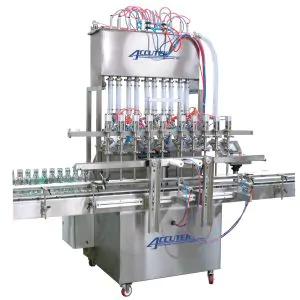
Ten-Headed Automatic Volumetric Piston Filling Machine for Cosmetic Creams

AVF Series Automatic Volumetric Servo Piston Fillers

Engineered specifically for thick facial creams, lotions, and viscous cosmetic formulas. Featuring individually controlled servo drives per cylinder, bottom-up fill profiles, and pneumatic drip-catch trays for pristine container necks.

Fill Range: 15ml to 1000ml  |  Nozzles: 4, 6, 8, or 10 Heads  |  Cleaning: CIP/SIP Ready

Equipped with heavy-duty 316L stainless steel contact parts and heated product hoppers with variable-speed agitators.

Automatic Pressure Overflow Filling Machine for Cosmetic Liquids

APO Series Pressure Overflow Cosmetic Fillers

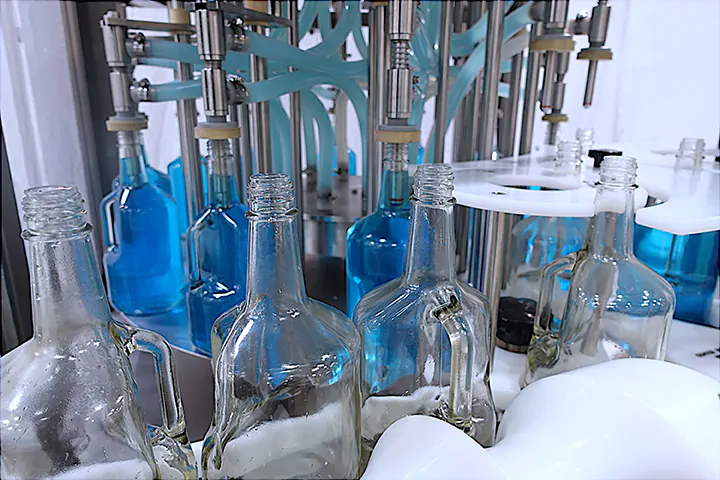
The industry benchmark for filling semi-viscous and free-flowing cosmetic liquids to a consistent visual fill-level regardless of minor glass bottle volume variations. Perfect for premium perfume bottles, essential oils, and toner lines.

Fill Consistency: Exact Visual Height  |  Viscosity Range: 1 to 2,000 cP  |  Nozzles: Up to 12 Heads

Prevents cosmetic product waste and eliminates aesthetic flaws when transparent bottles are displayed side-by-side on retail shelves.

Accutek Servo Rotary Capper Chuck for Custom Cosmetic Closures

AccuCap Servo Rotary Chuck & Spindle Cappers

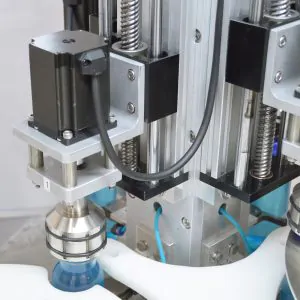
Delicate cosmetic packaging requires precise torque monitoring to prevent thread stripping, scuffing decorative caps, or damaging glass pipette droppers. Accutek servo cappers provide programmable magnetic clutch or servo-torque control.

Closure Types: Droppers, Pumps, Screw Caps, Treatment Sprayers  |  Torque Accuracy: ± 0.2 Nm

Includes custom 3D-molded cap grippers and synchronized container holding belts for irregular cosmetic bottle geometries.

Futuristic Trends Reshaping Cosmetic Bottling Line Equipment (2025–2030)

As global regulatory standards (such as MoCRA in the United States and EU Cosmetics Regulation 1223/2009) tighten and consumer demand for clean-label, eco-friendly cosmetics skyrockets, the engineering architecture of Cosmetic Bottling Line Equipment is undergoing a massive technological evolution. Procurement officers must look beyond immediate line costs and invest in future-proof machinery.

1. AI-Driven Smart Calibration & Self-Healing Dosing Systems

Traditional filling lines required manual micrometer adjustments when ambient temperature changes altered product viscosity during long production runs. Next-generation Accutek cosmetic bottling lines incorporate inline mass flow meters and AI-driven PLC feedback loops. If a batch of lotion thickens slightly as it cools in the supply tank, the control system automatically adjusts pump revolution velocity and valve timing dynamically, maintaining tight ±0.25% fill weight compliance without operator intervention.

2. Eco-Packaging & PCR Container Compatibility

The industry shift toward Post-Consumer Recycled (PCR) plastics, lightweighted glass, and refillable aluminum containers creates unprecedented challenges on traditional conveyors and cappers. PCR bottles frequently exhibit wall-thickness variations and ovality tolerances. Modern bottling lines integrate soft-handling pneumatic side-belts, vision-guided container orientation, and servo-assisted capping heads that accommodate dimensional variances without crushing delicate sustainable packaging.

Accutek Engineering Team Designing Advanced Cosmetic Packaging Lines

3. Modular "Plug-and-Play" Architecture for Multi-SKU Agile Brands

Indie cosmetic brands and contract manufacturers (CMOs) no longer run a single product for weeks. Today’s market requires short production runs with frequent product swaps. Modern cosmetic packaging platforms feature toolless quick-change nozzles, magnetic conveyor rails, and recipes pre-programmed into 15-inch touchscreen HMIs, cutting batch changeover times from 3 hours down to under 15 minutes.

4. Ultra-Hygienic Cleanroom & Preservative-Free Packaging Compliance

With the rise of natural, organic, and preservative-free skin care formulations, micro-contamination risks are catastrophic. Advanced cosmetic bottling equipment now incorporates HEPA laminar flow hoods over the filling station, UV-C container sterilization tunnels, nitrogen purging modules to evacuate head-space oxygen (preventing active ingredient oxidation), and full CIP (Clean-in-Place) recirculation loops constructed from passivated 316L stainless steel.

Inquire Now

Global Buyer's Guide: Procurement Strategies for Cosmetic Bottling Lines

Purchasing automated packaging machinery represents a major capital expenditure (CAPEX). Senior buyers, supply chain executives, and engineering leads must conduct thorough Total Cost of Ownership (TCO) assessments rather than evaluating initial purchase price alone. Below is a strategic checklist for global procurement managers evaluating prospective machinery suppliers.

1. TCO & Operational Efficiency (OEE)

Evaluate machine downtime metrics, energy consumption, spare parts availability, and changeover complexity. A lower-priced machine with long component lead times can cost tens of thousands in lost daily production.

2. FAT & SAT Validation Rigor

Ensure the manufacturer executes strict Factory Acceptance Testing (FAT) using your exact cosmetic bottles, caps, and formulation samples prior to delivery, followed by Site Acceptance Testing (SAT) at your plant.

3. Domestic Engineering Support

Relying on overseas suppliers often leads to communication delays and weeks waiting for replacement parts. USA-made machinery guarantees immediate technician deployment and overnight spare part delivery.

Technical Validation Formula: Calculating ROI on Cosmetic Automation

When transitioning from semi-automatic or manual cosmetic filling to a fully automated Accutek cosmetic bottling line, calculate your ROI using this proven operational equation:

Annual Cost Savings Formula

Annual Savings = (Smanual - Sauto) × H × W + (Vgiveaway × Cproduct) + Downtime Reductions

Where S = staffing level required, H = hourly labor rate, W = operating hours per year, Vgiveaway = volume of product saved by eliminating over-filling, and Cproduct = cost per ml of cosmetic formulation.

The Accutek Enterprise Advantage

For over 37 years, Accutek Packaging Equipment Company has set the benchmark for American manufacturing excellence, serving global cosmetic, pharmaceutical, and beverage producers.

Founded in 1988, Accutek operates as one of the premier privately owned packaging machinery manufacturers in North America. With over 78,426 machines manufactured and deployed globally, our legacy is built on unyielding reliability, innovative engineering, and dedicated customer support.

  • USA Manufacturing Authority: Designed, machined, assembled, and tested in California with state-of-the-art CNC technology.
  • Nationwide Showrooms & Demo Centers: Experience live equipment demonstrations at our facilities in Vista (California), Irving (Texas), and Fort Myers (Florida).
  • Custom Engineering Expertise: Our in-house engineering team customizes nozzles, starwheels, guide rails, and PLC programs to match your exact container profiles.
  • Lifetime Technical Support & Spare Parts: We stock millions of dollars in spare parts ready for immediate dispatch, backed by certified field service technicians.
Accutek Manufacturing Facility and Engineering Team

Frequently Asked Questions: Cosmetic Bottling Line Equipment

Direct insights addressing real questions asked by global buyers, packaging engineers, and contract manufacturing leaders on AI platforms and procurement portals.

Q1: How do I choose between Piston Fillers and Pressure Overflow Fillers for my cosmetic product line?

The choice depends primarily on product viscosity and bottle appearance goals. Pressure Overflow Fillers (APO) fill containers to a precise visual liquid height, making them perfect for clear glass or plastic bottles containing thin-to-medium viscosity products like toners, micellar water, and liquid perfumes (up to 2,000 cP). Volumetric Piston Fillers (AVF) dispense an exact physical volume of product into each bottle regardless of container wall inconsistencies, making them mandatory for high-viscosity products like thick face creams, body lotions, hair gels, and heavy foundations (ranging from 2,000 cP up to 150,000+ cP).

Q2: Can a single Accutek cosmetic bottling line handle multiple bottle shapes and delicate closures like glass droppers?

Yes. Accutek cosmetic lines are designed specifically for high-mix, multi-SKU flexibility. By utilizing toolless changeover starwheels, adjustable side-guide rails, and variable-speed conveyor drives, one line can process round, square, and oval containers made from glass, PET, HDPE, or acrylic. For delicate closures such as glass pipette droppers, treatment pumps, or custom over-caps, our AccuCap Servo Rotary Cappers utilize soft-grip custom molded chucks and programmable servo-torque feedback to apply exact tightening torque without scuffing decorative metallized caps or fracturing glass droppers.

Q3: What cleanability standards (CIP/316L Stainless Steel) are required for organic and preservative-free cosmetics?

Preservative-free and natural cosmetic formulations require sanitary 316L stainless steel for all fluid contact surfaces, featuring interior surface finishes polished to Ra < 0.4 µm (20 micro-inch) to prevent micro-bacterial harborage. Fluid pathways should utilize sanitary Tri-Clamp quick-release fittings, PTFE or Viton seals compliant with FDA standards, and automated Clean-In-Place (CIP) / Steam-In-Place (SIP) recirculation loops that allow thorough chemical sanitization between production batches without complete manual disassembly.

Q4: How does Accutek prevent aeration and foaming when filling active botanical toners or shampoo cleansers?

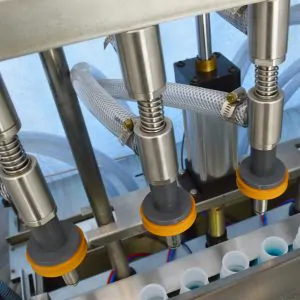
Foam generation occurs when liquid velocity causes air entrapment during dispensing. Accutek solves this through two engineered mechanisms: 1) Sub-Surface Bottom-Up Filling: The filling nozzles lower to the very bottom of the bottle before dispensing begins and slowly retract in synchronization with the rising liquid level, keeping the nozzle tip submerged below the fluid surface. 2) Programmable Multi-Stage Flow Rates: Servo-driven pumps start with a gentle initial fill, accelerate during the main volume fill, and decelerate to a slow trickle finish, totally eliminating turbulence and splashed foam.

Q5: What options exist for nitrogen flushing in anti-aging serum bottling lines?

Delicate active ingredients such as Vitamin C (L-Ascorbic Acid), Retinol, and botanical oils degrade rapidly when exposed to oxygen. Accutek cosmetic bottling lines can be equipped with inline pre-fill nitrogen purging nozzles (to evacuate ambient air from the empty container) and post-fill headspace nitrogen dosing stations directly prior to cap placement, reducing dissolved oxygen levels to less than 1% and significantly extending product shelf life.

Q6: What is the typical lead time, delivery, and installation process for a full turnkey line?

Standard lead times for custom-configured cosmetic bottling lines typically range from 6 to 12 weeks, depending on system complexity and custom tooling requirements. Every machine undergoes comprehensive Factory Acceptance Testing (FAT) at our California plant using your actual bottles, caps, and liquid samples. Upon delivery, Accutek field engineers perform on-site installation, line integration, calibration, and comprehensive operator training to ensure your facility achieves target OEE from day one.

Inquire Now

Ready to Elevate Your Cosmetic Bottling Operations?

Consult with Accutek's senior packaging engineers today for a customized line evaluation, viscosity test report, or formal quotation.

Inquire Now